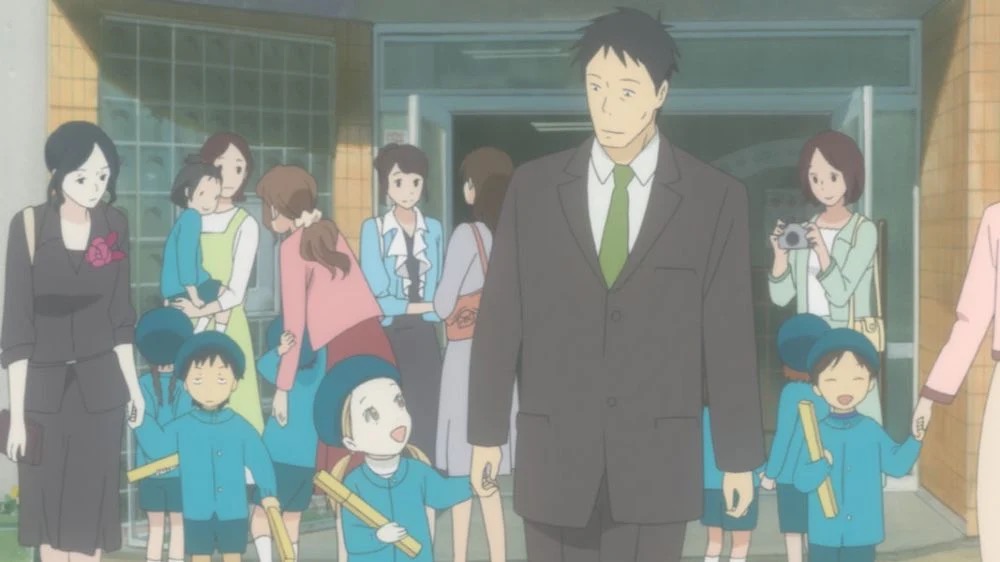
For Daikichi Kawachi, attending his dearly departed grandfather’s funeral was supposed to be a cut-and-dried affair. However, upon arrival, he quickly learns that things are a little…awkward. Grandpa, you see, still had a bit of gas left in the tank and secretly fathered a child: a shy six-year-old girl named Rin. She doesn’t talk to strangers (finally, a kid in anime that gets it) and tends to run away whenever anyone speaks to her. This may have something to do with Daikichi’s family, who are perplexed and embarrassed by the situation, treating our little bellflower more like an inconvenience than a living, breathing, grieving child. When Daikichi hears the family is planning to drop Rin off at the local orphanage, he decides to take matters into his own hands and take the little girl in. There’s just one teeny-tiny problem…Daikichi has ZERO clue how to raise a child. Like, ZERO. However, he knows that Rin needs a home and, for the time being, he’s the only family she’s got. How will our bachelor businessman balance sudden single parenthood? Cue the Bunny Shenanigans!

…but first, let’s have a little talk.
Bunny Drop (also known as Usagi Drop) is a series overshadowed by the controversies of its source material. Once seen as a comforting slice-of-life story, it is now the kind of series everybody knows, but nobody talks about, at least not without deep shudders, pointed glances, and exasperated sighs. Without going into spoilers for the manga, the father/daughter relationship between Daikichi and Rin gets murky. Real murky. Like “Water in the Gulf of Mexico during the Deepwater Horizon Oil Spill” murky. You can find out what happened yourself if you Google it, but suffice it to say, Bunny Drop’s ending could be seen as being a bridge too far, and spoils all the good will and warm feelings that comes before, including the chapters that this anime covers.
But is that really fair?

Are we being too harsh on what, within its 11 episodes and four half-episodes, is a really sweet, heartwarming story about the ups and downs of raising a child and what it really means to be a parent? Can we, as an anime community, separate Yumi Unita’s controversial manga from the anime and enjoy the latter for what it is, without the former’s sins?
In the immortal words of Barack Obama, yes we can! And concerning this anime, yes we totally should: Bunny Drop is one of the most heartwarming, endearing anime I’ve ever come across. Even with the somewhat oddball circumstances, mostly involving Rin’s origins, the baseline story of being a guardian to a young child and the challenges and rewards therein is something that most of the viewing audience can relate to, myself included.

While I’ve never been a father, and at the rate things are going, I may never be, I am, in fact, an uncle, and I’ve found myself sharing space for a while with my nephew after my sister’s sudden passing when he was around Rin’s age. It was a complex, confusing time, with emotions running high across the board. I had a lot that I had to deal with mentally and emotionally, and dealing with a young child was something I had next to no experience with, which led to periods of frustration and immaturity on my part. But thankfully, things settled down, and my nephew has become a very intelligent, caring, creative, and hard-working man who, to say I’m proud of him, is the understatement of the year. Nephew, if by some oddball chance you’re reading this, know that the singular greatest honor I have had in my life was being your uncle and watching you grow up into the man you have become. I know beyond a shadow of a doubt that your mother would be PRODIGIOUSLY proud of you. Lord knows I am.

In any case, as I watched Bunny Drop, I couldn’t help but compare Daikichi’s struggles with what I’ve experienced and witnessed, which shows how realistic and true-to-life this show is. As caretakers of young kids, we’ve all had to deal with finding emergency child care, dealing with sudden illnesses/injuries, or even dealing with other parents who are in similar situations. Yes, just as parenting isn’t done in a vacuum, nor is this show’s plot, as we are given several different parent/kid combinations, with Daikichi taking something from each one in his journey as Rin’s guardian. Whether it’s fellow single parent Yukari and her ball of energy son Kouki or Daikichi’s cousin Haruko and her daughter Reina, our guy has to learn on the fly and keep things together to make sure this little bellflower has a great start in life, considering her sad and somewhat complicated origins.

The ending is textbook slice-of-life; no major epiphanies reached, no Key of the Twilight discovered…just a walk away from these two characters that we’ve shared time with for 11 episodes; secure in the knowledge that Daikichi and Rin have now settled into their new lives and are ready for what comes. We aren’t left with the impression that Daikichi has become some sort of super parent who has all the answers, nor do you think that Rin has become the perfect child. But you are left with the impression that these two will, like the Beatles once said, get by with a little help from their friends. You couldn’t ask for a better, more appropriate slice-of-life ending, and thankfully…THANKFULLY…this is where we leave them in the anime. We didn’t need anything more.

The copy of Bunny Drop I’m reviewing is the first Blu-Ray/DVD release from 2013 as seen above. At the time of writing, this version is no longer available, replaced by a Blu-Ray-only release, which is the same dang thing. You don’t get much with this release—the original 11 episodes plus four “half” episodes, clean openings, clean endings, and the Japanese commercial. Also, this is Sub-Only; no English dub is available, which is a crying shame, since several VAs would be excellent in the roles. Maybe the controversy of the manga struck again, and no director wanted to go within a mile of this one. Meh, who’s to say. What I will say is that, if you are interested in getting this one, I recommend getting it NOW. We are currently experiencing a moment in time where shows are starting to go out of print, and it’s only a matter of time before Bunny Drop hops away, with remaining stocks being marked up to high, high, high heaven.

Bunny Drop was created in 2011 by Production I.G., but honestly, if you told me this was a Ghibli production, I would totally believe you. I’m a trusting dope like that. The soft watercolors and the slow vibes remind me of something I would see in a Miyazaki production, not from a company that gave us Blood+, Eden of the East, Sands of Destruction, or Moribito: Guardian of the Spirit (Speaking of, happy belated birthday to the English V/A of Chagum, the always awesome Mona Marshall!). Series Director Kanta Kamei really did the dawg gone thing with this one, giving us a beautifully animated work with a soft yet striking color palette. This show does a great job showing us the whimsy of a child’s view of the world while keeping us grounded in real-world aesthetics. Any parent can recognize the gap-tooth grins, the rain-soaked socks, or the fever-flushed cheeks of illness in this one. From a musical standpoint, Bunny Drop does a lot with a little. This one has several musical cues and themes, including a piano version of our OP and ED, and it does the job very well: out of the way but present and nostalgic.

Speaking of music, the OP, “Sweet Drops”, is brought to us by PUFFY. Yes, THAT PUFFY—the dynamic duo who took over the US in the early 2000s with the awesome Teen Titans theme and eventually their own show, Hi Hi Puffy AmiYumi. It’s a cute, catchy little song that does threaten to turn into an earworm, but thankfully PUFFY pulls it off. In fact, the duo makes a cameo in Episode 8. Speaking of Hi Hi, our ending theme, “High High High,” is performed by Kasarinchu and is an absolutely perfect fit. While “Sweet Drops” could be seen as being a “Rin” song, the nostalgic feeling of “High High High” sounds like a song made for Daikichi as he watches Rin play in the yard. Also, if you watch the ending sequence for each episode, you’ll notice that it changes each time based on the events of the next episode!

So where does that leave us with Bunny Drop? If we look at this show with the fine-tuned laser focus of what we are DIRECTLY given on these Blu-Rays and nothing more…then this is absolutely a show I have no problems recommending. Bunny Drop is a show that has to fight through the dirt of its predecessor’s reputation to shine, much like the bellflowers our little adorable dork is named for. This anime stands up very well on its own two feet because of it’s relatable nature and loveable characters, coupled with excellent production quality. Thankfully our story ends in such a way that you really don’t have to (and SHOULDN’T) seek out more of the narrative. Just imagine that Rin and Daikichi go on having their own little adventures.
You can enjoy a hamburger without going to the butcher.
Bunny Drop is available for streaming on Crunchyroll
Leave a Reply